Security Robots: Rent or Buy
Autonomous patrol, monitoring and deterrence, security robots watch sites around the clock and stream to your control room. Compare 2026 pricing and the companies behind them.
How much does it cost to rent a security robot? Security robot rental pricing varies by model, operator and service level (see verified rental pricing on our data hub), and many providers offer a monitored robot-as-a-service at roughly $3,000 to $9,000 per month. Buying ranges from about $10,000 for an indoor or tower unit to $75,000 for an outdoor autonomous patrol robot.
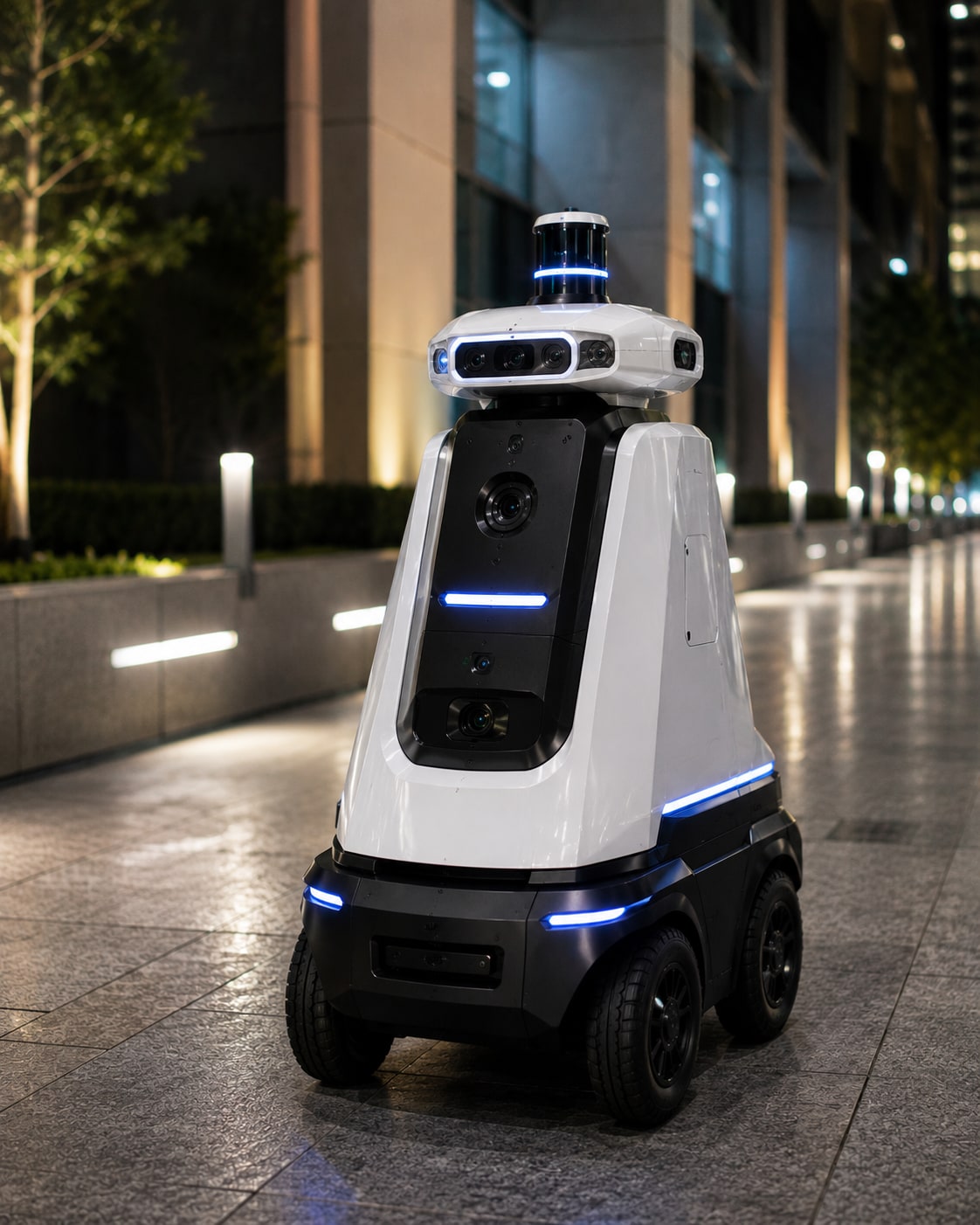
Security robots extend a guard force without adding headcount.
Read more
A single unit patrols a fixed route or wanders autonomously, carrying a mast of cameras, thermal imaging, licence-plate readers, two-way audio and often gas or sound sensors, and streams everything back to a monitoring centre in real time. Some are stationary towers that watch a car park; others are wheeled or four-legged robots that cover perimeters, warehouses and campuses on repeatable loops. Their value is not that they replace human judgement, it is that they never get bored on the third lap at 3am, and they see in the dark.
The economics favour deterrence and coverage. A visible patrol robot discourages theft and trespass, while its sensors flag anomalies, an open door, a person in a restricted zone, an unusual heat signature, for a remote operator to assess and escalate. That lets one guard supervise far more ground than a foot patrol ever could, and puts eyes on remote or hazardous areas that are unpleasant or unsafe to staff. This guide covers the security segment, indoor patrol robots, outdoor autonomous units, stationary towers and quadruped inspection robots, with real 2026 rental and purchase pricing and the companies that supply them.
What are security robots used for?
Security robots pay for themselves in coverage and deterrence. The most common jobs are:
- Perimeter & site patrol. Cover fence lines, yards, car parks and campuses on repeatable loops, day and night, streaming live video to a control room.
- Monitoring & anomaly detection. Flag intruders, open doors, crowds, heat signatures and licence plates for a remote operator to assess and escalate.
- Visible deterrence. A conspicuous patrolling robot discourages theft, vandalism and trespass simply by being seen.
- Hazardous & remote inspection. Enter areas that are unsafe or costly to staff, substations, tunnels, industrial sites, and report back.
- After-hours coverage. Watch empty offices, retail and warehouses overnight when human patrols are thin or absent.
How much do security robots cost?
Security robots are usually offered as a monitored service, so monthly subscriptions are common alongside outright purchase. Typical 2026 ranges:
| Engagement | Typical 2026 range | What it usually includes |
|---|---|---|
| Daily rental | See verified rates · Request a quote | Per robot, with delivery, setup and monitoring; higher end for outdoor autonomous units. |
| Monthly service | $3,000 to $9,000 / mo | Robot-as-a-service including monitoring, maintenance and software. |
| Purchase: indoor / tower unit | $10,000 to $40,000 | Stationary tower or indoor patrol robot with camera suite. |
| Purchase: outdoor autonomous | $40,000 to $75,000 | All-weather patrol robot with autonomous navigation and full sensor stack. |
Ranges reflect typical 2026 commercial pricing across the BuyAndRentRobots.com directory and vary by region, duration, configuration, staffing and support. Submit a free inquiry for exact quotes from matched companies.
Which businesses use security robots?
Security robots sell to operators guarding large or sensitive sites on tight guard budgets:
- Logistics & warehousing, patrolling yards, docks and perimeters overnight.
- Commercial real estate, covering car parks, lobbies and campuses after hours.
- Retail & shopping centres, deterring theft and monitoring car parks.
- Critical infrastructure & utilities, inspecting substations, plants and remote sites.
- Corporate & data-centre campuses, perimeter patrol and access monitoring.
- Events & construction sites, temporary coverage of large, changing footprints.
Rent vs buy security robots
The rule of thumb: rent for moments and trials, buy for programs.
Rent a security robot
- No capital outlay: pay per day or per month.
- Monitoring, maintenance and software typically included.
- Stand up coverage for an event or build in days.
- Scale patrols up or down as a site changes.
- Vendor handles updates, repairs and charging.
Buy a security robot
- Lower cost per patrol-hour at continuous, year-round use.
- An owned asset integrated with your control room and VMS.
- Full control of routes, alerts and data retention.
- Break-even often lands within 12 to 24 months versus added guard hours.
- Plan for connectivity, charging and monitoring staff.
Featured security robot companies
Companies that rent and sell security robots, look for the blue Verified Partner badge on confirmed partners. Tap through for profiles, catalogues and quotes.
Available security robots
Specific security robot models listed for rent or purchase right now.
Security Robots: frequently asked questions
What is a security robot?
A security robot is an autonomous or stationary robot that patrols and monitors a site, carrying cameras, thermal imaging, two-way audio and other sensors and streaming live data to a monitoring centre. It provides deterrence and 24/7 coverage that supplements a human guard force.
How much does it cost to rent a security robot?
Security robot rental pricing varies by model, operator and service level (see verified rental pricing on our data hub), and many providers offer a monitored robot-as-a-service at roughly $3,000 to $9,000 per month. Buying ranges from about $10,000 for an indoor or tower unit to $75,000 for an outdoor autonomous patrol robot.
Do security robots replace human guards?
No. They extend a guard force by handling repetitive patrols and continuous monitoring, so officers focus on response and judgement. A remote operator assesses the alerts a robot raises and dispatches people when a situation needs a human.
Can security robots operate outdoors at night?
Yes. Outdoor security robots are weather-sealed and equipped with night vision and thermal cameras, so they patrol effectively in darkness and poor weather, often their most valuable shift, when human patrols are thin.
What can a security robot actually do if it detects a threat?
It alerts a monitoring centre, streams live video, can issue a recorded or live two-way audio warning, and logs the event, but it does not physically intervene. A human operator decides whether to escalate to on-site officers or law enforcement.
Find your security robot
Compare security robot companies, or tell us what you need and get matched with the ones that fit, free to search.